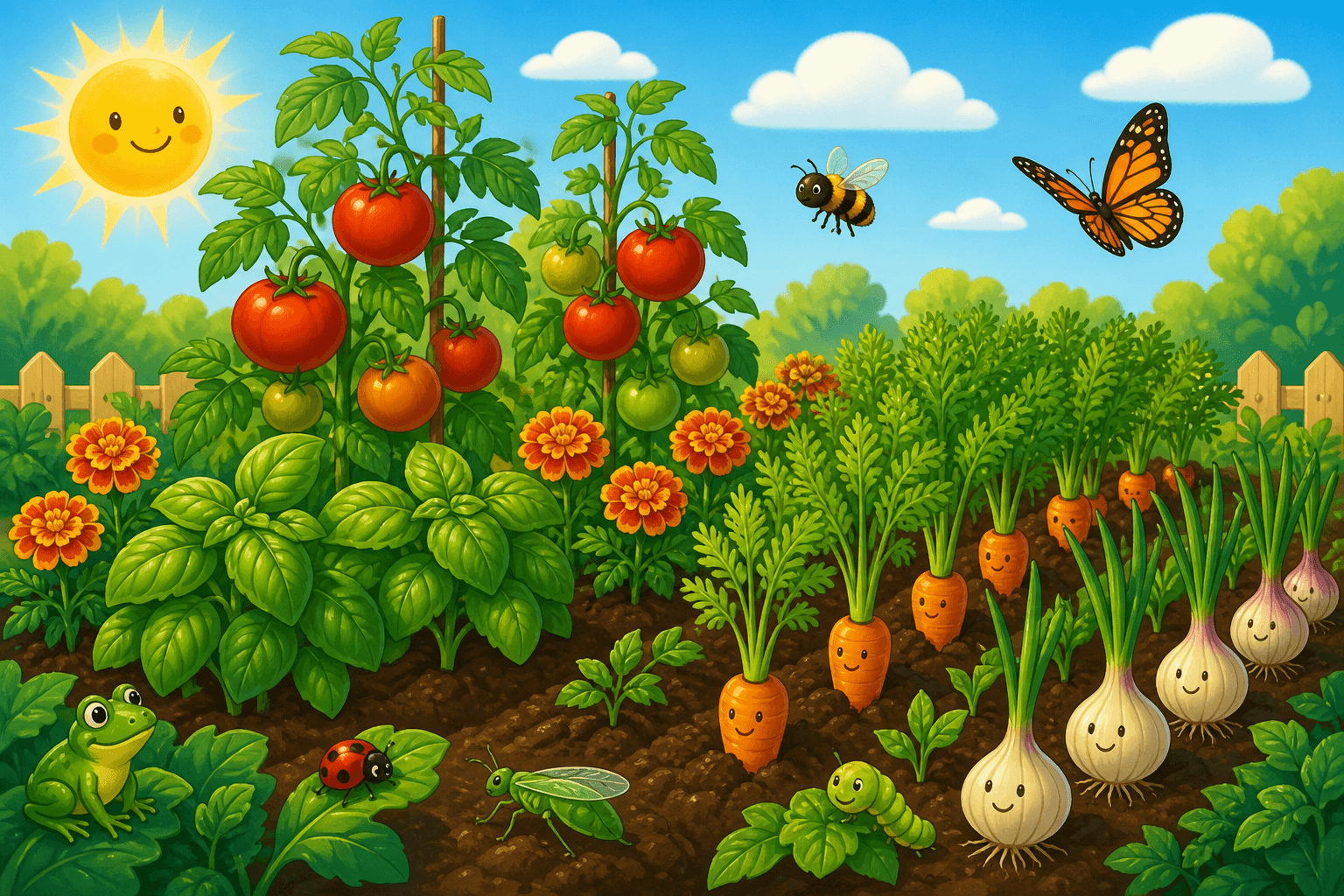
The Art of Companion Planting
Gia Kaye · Jolly Pond Living Series
Harmonious pairings for vegetables, flowers, and a garden that helps itself.
$1.99
You’ll learn
- Vegetable partnerships that share nutrients, shade, and pest protection in a tight kitchen patch.
- Flower pairings that invite pollinators and keep aphids and beetles off the food crops.
- Which garden marriages to avoid so blight and stunted harvests stay out of the beds.
Contents
- Welcome to the Garden: The Secret Conversations in the Soil
- Chapter One: Vegetable to Vegetable: Kitchen Patch Best Friends
- Chapter Two: Flower to Flower: Beauty, Scent & Ecological Harmony
- Chapter Three: The Garden Marriage: Pairing Vegetables with Flowers
- Chapter Four: The Mischief Makers: Garden Pairings to Avoid
- Chapter Five: Master Companion Planting Quick-Reference Matrix
- References & Further Reading
Look inside
The Secret Conversations in the Soil
If you sit quietly in the garden on a warm summer morning, you quickly realize that a garden is never just a collection of separate plants in tidy rows. It is a lively, bustling neighborhood. Just like any community, some neighbors bring out the very best in each other, while others simply cannot stand sharing the fence line.
Companion planting is nothing more than the gentle art of understanding these relationships. For generations, traditional gardeners and homesteaders have observed that certain plants thrive when grown side by side. Modern science now backs up what our forebears knew instinctively: roots exchange vital nutrients, foliage releases pest-repelling essential oils, dynamic taproots pull deep minerals to the surface, and vibrant blossoms call in an army of pollinators and beneficial predatory insects.
When we step away from sterile monoculture and mimic natural ecosystems, our garden beds transform. We spend far less time spraying pest treatments, weeding exposed soil, and worrying about synthetic fertilizers. Nature does the heavy lifting for us—provided we make the right introductions.
The core benefits begin with natural pest deterrence: strong scent profiles mask your prized crops from hungry pests or actively drive them away. Trap cropping uses sacrificial companion plants to draw insects away from vulnerable main vegetables. Soil conditioning and nutrient sharing happen when deep taproots break heavy clay, while legumes fix atmospheric nitrogen for their neighbors. Tall sun-lovers provide cool shade for tender greens or offer sturdy living trellises for climbing vines.
In this guide, we will explore three vital categories of companionship: Vegetable to Vegetable, Flower to Flower, and the powerhouse synergy of Vegetable with Flower. We will also touch on the garden “frenemies” you should always keep separated. Pull up a garden stool, pour a cup of tea, and let’s explore the magic of garden pairings.
Chapter One: Vegetable to Vegetable: Kitchen Patch Best Friends
Pairing vegetables with other vegetables is the foundation of productive, space-efficient gardening. When planned thoughtfully, companion vegetables maximize every square foot of your raised beds, hügelkultur mounds, or in-ground rows.
The most famous indigenous companion grouping remains the gold standard of vegetable synergy: corn as the sturdy trellis, climbing beans fixing nitrogen at the roots, and winter squash spreading a living mulch that keeps soil cool and moist. Tomatoes produce solanine, which deters carrot rust flies, while carrots loosen heavy soil around tomato roots without competing for canopy sunlight.
Preview only. The full book will be sold when checkout opens.