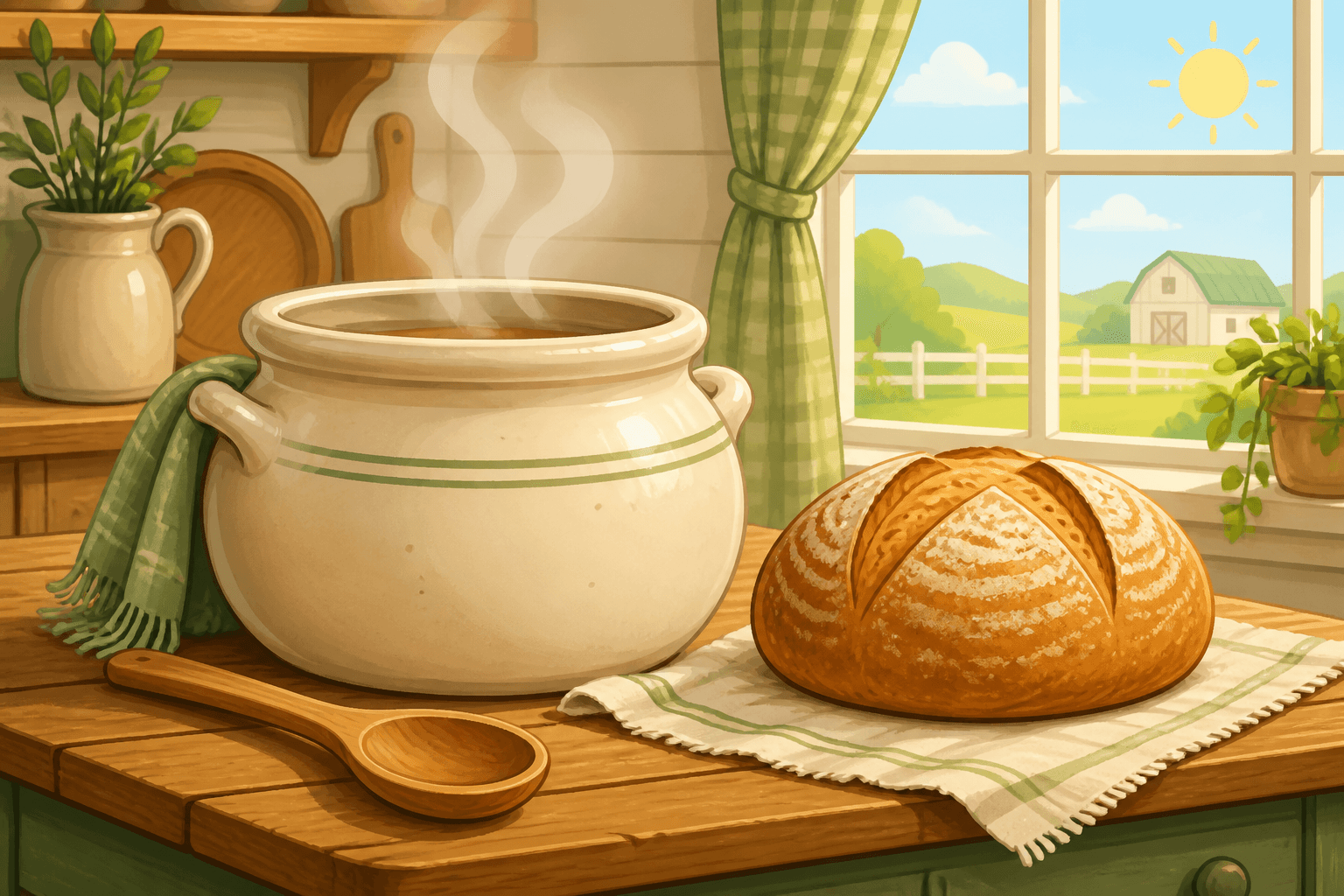
The Living Crock
Gia Kaye · Jolly Pond Living Editions
A no-discard sourdough guide for kitchens that never throw flour away.
$1.99
You’ll learn
- How to keep a living starter with jar scrapings instead of daily discard.
- How older kitchens treated flour as precious, and why that rhythm still works.
- How to tell when a starter is ready to bake by rise, scent, webbing, and the float test.
Contents
- Welcome to the Hearth
- How Prior Generations Baked: Precious Flour & True Thrift
- The Science of the Crock Made Simple
- How to Assess Your Starter: Is It Ready to Bake?
- Simple Everyday Hearth Loaf
Look inside
Welcome to the Hearth
If you have ever felt a twinge of guilt scraping cup after cup of thick flour batter straight into the compost bin just to keep a glass jar alive, you are not alone. In recent years, modern baking tutorials have popularized a method of daily feeding that treats flour like a disposable medium. We are instructed to stir, measure, and immediately throw half away before feeding again.
To anyone with a heart for the homestead, a respect for pantry staples, or a memory of how our grandmothers ran their kitchens, this feels unnatural. And historically speaking, it truly is.
I wrote this little guide to welcome you back to an older, gentler rhythm. You can cultivate a vibrant, bubbly, incredibly resilient sourdough culture starting with nothing more than a few spoonfuls of flour and water—and you will never throw a single gram of it away.
In the quiet hours of the kitchen, bread is not just made; it is listened to. When we work with wild yeast, we step into a lineage of bakers who wasted nothing and trusted the slow magic of time.
How Prior Generations Baked: Precious Flour & True Thrift
Before commercial dry yeast packets appeared on grocery shelves in the mid-twentieth century, every loaf of leavened bread in human history was raised by wild fermentation. Starters were not fussy laboratory experiments; they were daily household companions.
Flour was never taken for granted. In our grandmothers' and great-grandmothers' days, grain had to be cultivated, harvested, milled, hauled home in heavy sacks, or purchased with hard-earned money. In pioneer kitchens, rural farmhouses, and mining cabins across the frontier, throwing out flour was simply not an option. Every scoop of flour was meant to nourish a family.
Traditional bakers rarely kept giant crocks of liquid starter churning on the counter between baking days. Instead, after mixing a batch of bread dough, they simply pinched off a small handful of dough—or left the unwashed mixing bowl and starter crock with just a scrape of residue at the bottom—and set it in the cool larder or cellar. When baking day came around again, fresh water and flour were stirred into those scrapings to wake the culture right back up.
Gold Rush prospectors in 1849 and Klondike miners in the Yukon treasured their starter crocks above almost everything else. During freezing sub-zero nights, they would take their sourdough pots right into their bedrolls to keep the living microbes from perishing. Starters became family heirlooms, passed from mothers to daughters and neighbors to neighbors over decades.
Preview only. The full book will be sold when checkout opens.